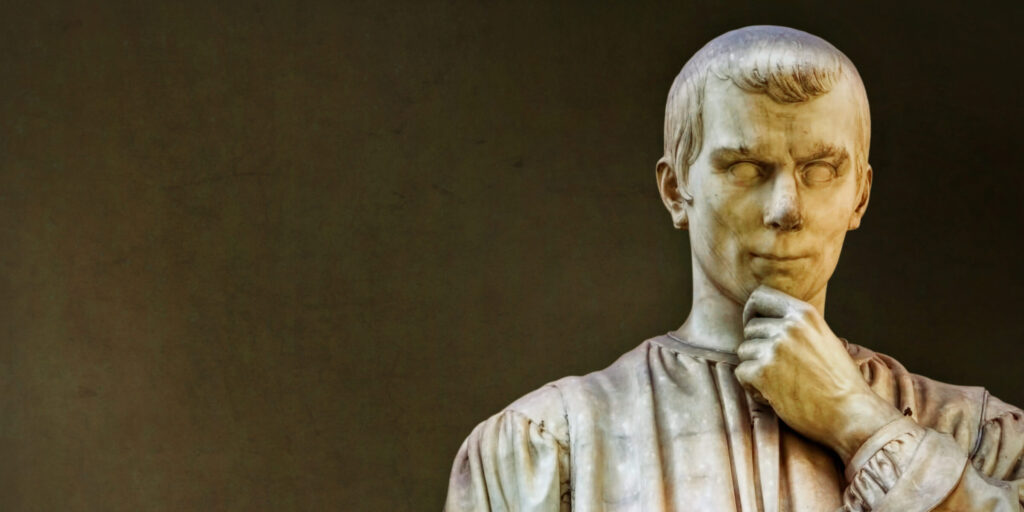
He was born in Florence in 1469 and, from a very young age, devoted himself to the study of mathematics and the humanistic disciplines, grammar and especially Latin, which gave him access to historiographical and philosophical readings of authors such as Lucretius, Terence, Livy and Marcus Junianus Justinus, as testified by his father Bernardo Machiavelli (Bernardo di Niccolò di Buoninsegna) in his Libro dei ricordi, albeit in the form of a financial record concerning the payment of tutors and the purchase of books.
His mathematical learning, but above all his philosophical, historical and military culture—although largely acquired through books—would later prove useful in obtaining and carrying out his republican offices: first as Secretary of the Second Chancery, then as Secretary to the Ten—the magistracy responsible for war and security—and finally as an envoy of the Florentine Republic at Italian and foreign courts. These posts were entrusted to him after the death and fall of Girolamo Savonarola, whom Machiavelli had already opposed while he was still alive.
His experience at the Italian courts led him to become a direct witness, between Emilia and Rome, to the abilities and cunning of Cesare Borgia, known as “the Valentino”. These qualities he would later describe in detail as those of a good prince in the work of the same name, The Prince (c. 1513), written largely during the period of enforced inactivity and exile at the Albergaccio (San Casciano Val di Pesa) following the fall of the Republic in 1512. The work was presented, as an attempt at captatio benevolentiae, to Lorenzo de’ Medici, Duke of Urbino and Medici ruler restored in Florence, who probably never read it.
Also in light of the already extensive documentation concerning the success of the translations of The Prince, our primary interest is directed towards the vernacular works composed after 1516, in the final period of Machiavelli’s life. During these years he was in close contact with Cosimo Rucellai and Zanobi Buondelmonti—to whom he owed the composition of the Discourses on the First Decade of Livy, and who appear among the principal interlocutors in The Art of War (De re militari)—as well as with other young intellectuals, mostly republicans, who gathered around the Orti Oricellari in Florence. Among them was also Lorenzo Strozzi, who enjoyed a good reputation with the Medici of Florence.
It was through this friendship that Machiavelli approached dramaturgy, composing during those years the comedy
Mandragola, which was first performed in Florence and later in Rome at the request of Cardinal Giulio de’ Medici. To him would be dedicated, during his pontificate, the
Florentine Histories, just completed and compiled at the Albergaccio under a modest payment from the Medici family.