
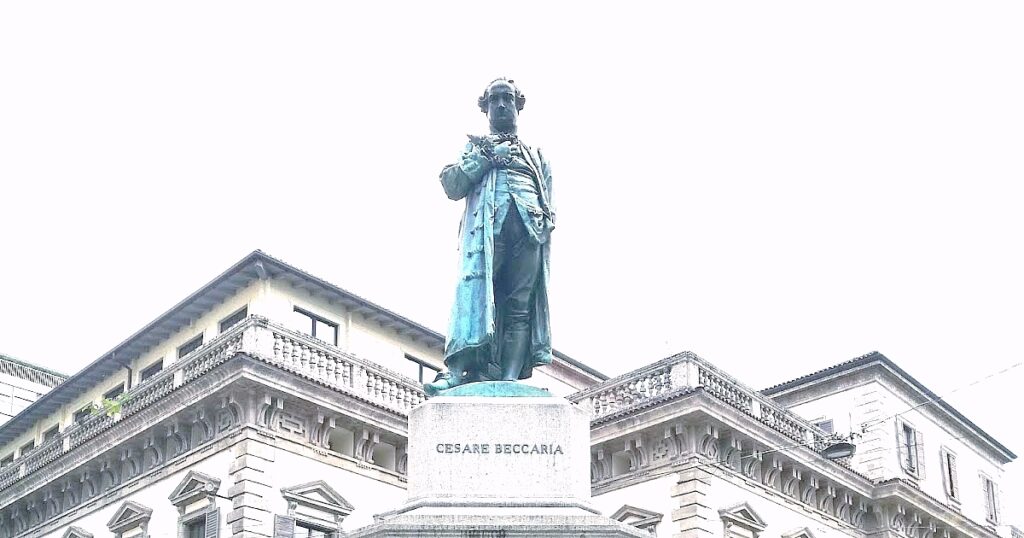
Cesare Beccaria was born in Milan in 1738 into a wealthy family of recently acquired aristocratic status. His private life and the mutual feelings of rejection between Beccaria and his family, particularly with his father, as well as the etiquette and mindset of the Milanese aristocracy, played a decisive role in the development of his revolutionary, avant-garde, and liberal ideas in the legal and social spheres, but also in literature: precisely against the dogmatism of codified literary genres, he gathered the thoughts already published in Verri brothers’ Il Caffè and published in 1770 the Ricerche intorno alla natura dello stile, endorsing the idea of the primacy of the author’s style over the norm and of art capable of elevating the human spirit.
In addition to his early mathematical aptitude and interest in economics, which also led to a desire to reform the evaluation of circulating currency according to the quantity of precious metals contained therein (Del disordine e de’ rimedi delle monete nello stato di Milano, 1762), he began cultivating an interest in literature – he was also an academic of the Trasformati – and philosophy, a passion for knowledge in its broadest spectrum. Initially, he engaged with his compatriots and French-speaking authors – already a friend of Pietro Verri, he read Rousseau and Montesquieu, and became acquainted with Hume, Diderot, and D’Alembert, among others – before fully taking his place among the most illustrious names of the Enlightenment, recognised also by contemporaries across the Atlantic. Already Thomas Jefferson and John Adams, then engaged with the birth of the new nation of the United States and future presidents, had read both the original work – in English translation (1767) and Italian – and the commentary quickly produced by Voltaire (1766).
The issues raised by critics of Beccaria’s analysis of currency management and exchange value, and the ensuing heated disputes among intellectuals, in which the Verri brothers defended Beccaria, led to the creation of the combative Milanese Accademia dei Pugni (Academy of Fists), which counted among its members the notable names of the young Italian Enlightenment, including the Marquis himself.
Cesare Beccaria, by then a qualified lawyer, was at that time the focal point of philosophical and legal discussion within the newly formed academy; a discussion that arose precisely concerning the legal issues raised by his criticisms and the resulting sharp polemics, and which was daily nourished by his experience of human misery reported in his work as a lawyer. In this context, within just one year (1763–1764), the Essay on Crimes and Punishments was written, informed by the constant and engaged readings of Jean-Jacques Rousseau’s recently published Contrat social (1762) and the meticulous notes he took on Francis Bacon (Francisci Baconis de Verulamio De dignitate et augmentis scientiarum et novo organo scientiarum libris excerpta, Biblioteca Ambrosiana, Becc. B 201).
His best-known and most influential work was translated and commented upon worldwide, with either approbation or indignation (e.g., Ferdinando Facchinei, Note ed osservazioni sul libro intitolato Dei delitti e delle pene, 1765), and it was particularly through commentaries such as Voltaire’s commentary par excellence (Commentaire sur le livre des délits et des peines par un avocat de province, 1766) that it came to be read, appreciated, and printed also in the newly formed United States of America. Little is known, at least systematically, about the dissemination of this work and the revolutionary ideas it contained after 1821, the year in which Cesare’s son, Giulio Beccaria, completed the bibliographic and anthological collection later delivered to the Biblioteca Ambrosiana, still the sole and most comprehensive collection of Cesare Beccaria’s manuscripts, letters, and works. In this vein, ENTRADIT aims to extend the account of the worldwide dissemination of the Essay on Crimes and Punishments up to the present day, within a context increasingly marked by the erosion of the very human and social rights that this book once inspired in modern thought.
Distribuzione delle traduzioni delle opere di "Dei delitti e delle pene" nel mondo

Bibliographic
Franco Venturi, Dizionario Bibliografico degli Italiani. Vol.7, Enciclopedia Treccani, 1970
[1] Tra le più accurate ricognizioni ragionate dell’influenza del pensiero beccariano nel mondo anglosassone di qua e di là dell’Atlantico è John Bessler, The Gross Injustices of Capital Punishment: A Torturous Practice and Justice Thurgood Marshall’s Astute Appraisal of the Death Penalty’s Cruelty, Discriminatory Use, and Unconstitutionality, «Washington and Lee Journal of Civil Rights and Social Justice» vol. 29-2(65), 2023, pp. 65-150 e Id., The Celebrated Marquis: An Italian Noble and the Making of the Modern World, Durham, Carolina Academic Press, 2018.
[2] Daniele Ruinetti, Cesare Beccaria tra innovazione e conformismo: il caso della moneta, «Studi Urbinati, A – Scienze giuridiche, politiche ed economiche» 61(45), 2021, pp.179-200
[3] Marialuisa Parise, Beccaria e Bacon: una fonte inglese alle origini del Dei delitti?, «Diciottesimo Secolo» vol.4, 2019, pp.19-31