
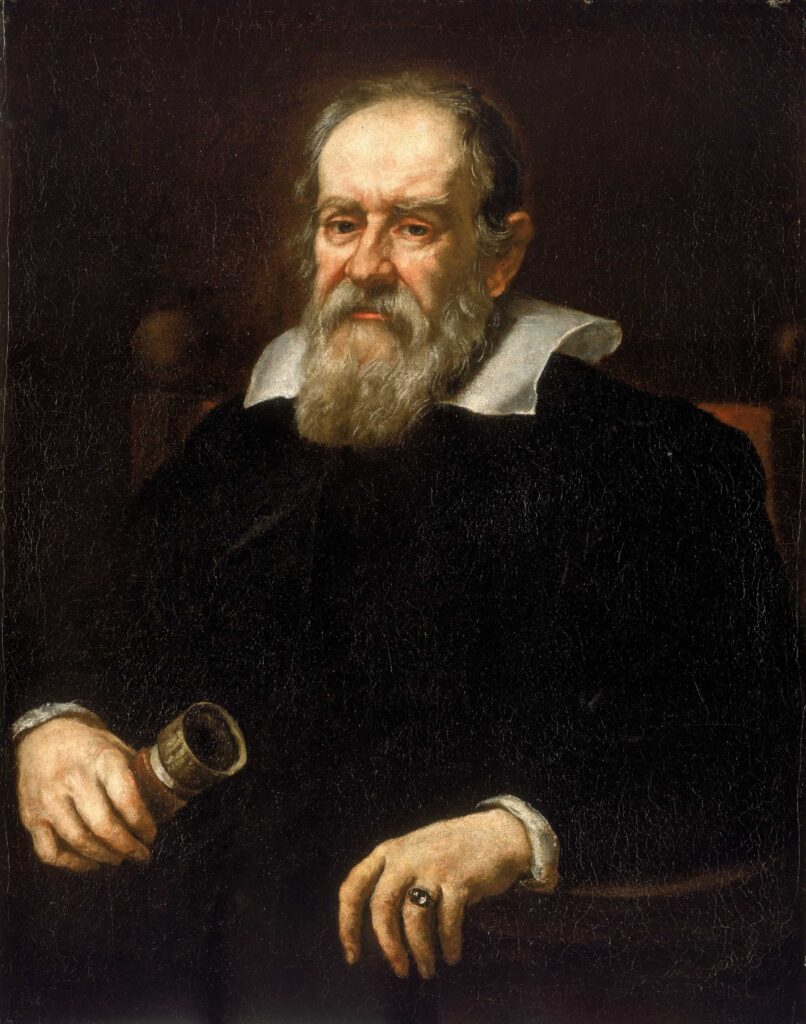
He was born in Pisa in 1564 and from an early age devoted himself to the formal cultivation of his artistic talent; yet before his university matriculation, around the age of sixteen, he developed a strong interest in the study of mathematics and Euclidean geometry. His earliest treatises, written in both Latin and the vernacular, are didactic essays on the construction and use of scientific and mechanical instruments, or mathematical demonstrations of theorems, logical structures and cosmological models; he soon, however, embarked upon the path of refuting certain Aristotelian dogmas through direct experimentation.
Observation and empiricism remained the foundations of the Galilean method throughout his career, both in his academic life and, for a short period in Padua, in a military capacity as an engineer and private adviser.
In 1597 Galileo Galilei became aware of the small European Copernican intelligentia and entered indirectly into an intermittent epistolary relationship with Johannes Kepler, following the donation to the chair of Padua of his astronomical work Mysterium Cosmographicum (1596) through Paul Homberger, at the request of the German astronomer himself, who wished to share his calculations and discoveries with the academies of Europe.
From this renewed scientific momentum, after returning to Tuscany as Mathematician and Philosopher to the Grand Duke, Galilei produced the inventions and works for which he is best known today: the telescope, technically described in Sidereus Nuncius (1610), dedicated to Cosimo II de’ Medici, and, after a considerable interval, The Essayer (1623), a masterful essay of literary and scientific polemic that in some respects anticipates the similar Dialogue Concerning the Two Chief World Systems (1624–1630), published in Florence in 1632 by Giovan Battista Landini.
With these two works a lively interest rightly arose, both among Galilei’s contemporaries and among modern scholars, in the curious choice to use the vernacular rather than Latin for writing on scientific subjects. The vernacular ensured the widest dissemination within Italy, even among detractors and inquisitors, whereas writing in Latin would have – and indeed later did, through the translations commissioned by Galilei himself – secured readers and supporters of Copernican theses throughout Europe.
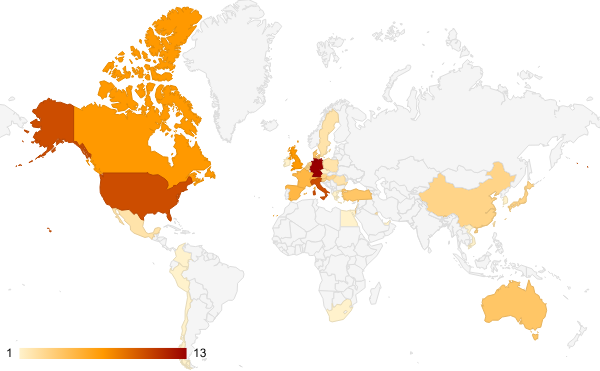
Although it cannot be denied that Galileo Galilei was familiar with Convivio by Dante Alighieri and its defence of the vernacular, based on the threefold argument of «cautela di disconvenevole ordinazione», «prontezza di liberalitade», and «lo naturale amore a propria loquela», it is perhaps more plausible to attribute this choice to the influence of Alessandro Piccolomini during Galilei’s Paduan period, as well as to his desire to attract the favour of the Medici family by simultaneously ennobling the political prestige of the Florentine language and the technological and scientific innovations made possible by the telescope and the experimental method, as attested by Galilei’s private correspondence.Distribuzione delle traduzioni di "Dialogo sopra i due massimi sistemi" nel mondo
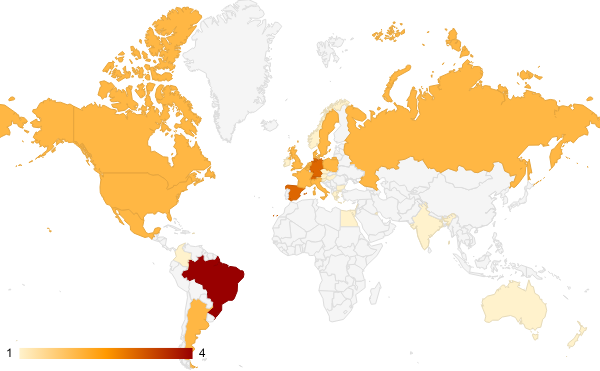
Distribuzione delle traduzioni di "Il Saggiatore" nel mondo
Bibliographic
Galilei, Galileo, Enciclopedia Treccani
[1] Marco Bianchi, Galileo in Europa. La scelta del volgare e la traduzione latina del Dialogo sopra i due massimi sistemi, «Filologie medievali e moderne» 23(19), Edizioni Ca’ Foscari, 2020, pp. 63-64
[2] Massimo Bucciantini, Galileo e Keplero. Filosofia, cosmologia e teologia nell’età della Controriforma, Einaudi, Torino, 2003, p. 22.
[3] Marco Bianchi, op. cit., pp. 17-18.
[4] Convivio, I, 5. Rispettivamente la coerenza tra la lingua propria della cosa trattata e la lingua della trattazione, la massima disponibilità di divulgazione presso i lettori contemporanei, e un amore dovuto per la propria lingua d’uso.
[5] Marco Bianchi, op. cit. pp. 18-23.
[6] Id., pp. 29-48.